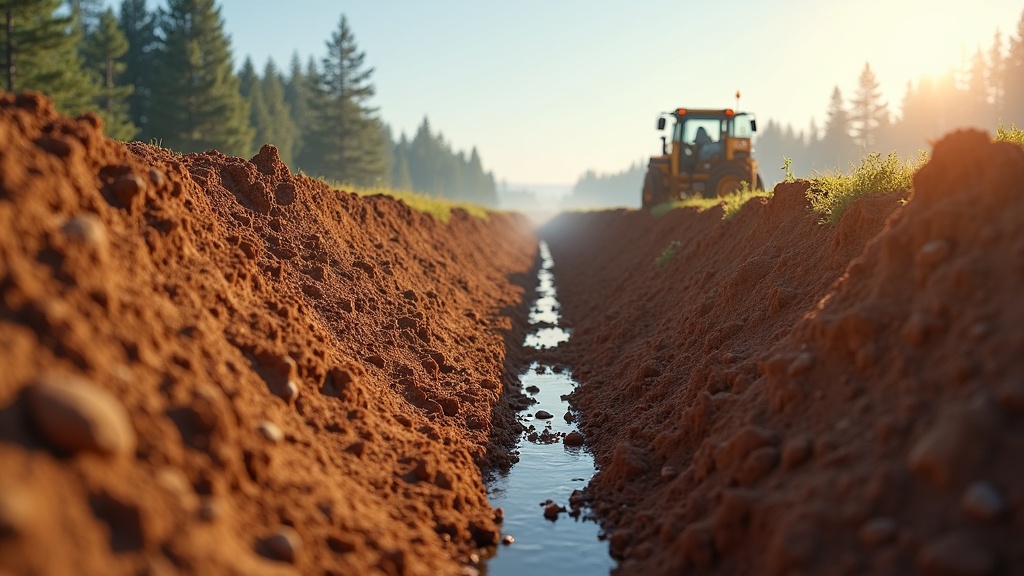
Trenching and Backfilling in Mining
Discover how trenching and backfilling in mining ensure structural stability. Learn about grout mixing, safety protocols, and modern site excavation methods.
Table of Contents
- Excavation Safety and Risk Management
- Engineering Standards for Soil Replacement
- Advanced Grout Mixing for Subterranean Voids
- Heavy Machinery and Compaction Techniques
- Your Most Common Questions
- Comparing Backfill Methods
- Practical Tips for Project Managers
- Final Thoughts on Trenching and Backfilling
Article Snapshot
Trenching and backfilling is the process of excavating linear ground cavities and refilling them with engineered materials to support mining infrastructure. This procedure stabilizes buried utilities, prevents ground settlement, and ensures long-term safety for heavy equipment operating on the surface above underground tunneling networks.
Quick Stats: Trenching and Backfilling
- The U.S. trench shoring equipment market is projected to reach 677.0 million dollars by 2030 (Grand View Research, 2024)[1].
- From 2011 to 2021, the U.S. construction industry accounted for approximately 85 percent of all fatal trenching injuries across all industries (CPWR, 2024)[2].
- Excavation contractors in the United States are projected to generate 142.5 billion dollars in industry revenue in 2026 (IBISWorld, 2026)[3].
Trenching and backfilling form the backbone of surface and subsurface infrastructure development in modern mining and tunneling projects. When crews excavate pathways for essential utilities, ventilation shafts, or drainage systems, the subsequent refilling process dictates the long-term stability of the ground. In heavy industrial environments, improper soil replacement can lead to catastrophic settlement, damaging critical pipelines and compromising the structural integrity of access roads. This article examines the core principles of ground excavation, the engineering requirements for stable soil replacement, and the advanced grout mixing techniques used to secure subterranean voids. We will also review vital safety protocols, compare traditional soil compaction with modern fluid backfill methods, and outline best practices for project managers overseeing these complex earthworks.
Excavation Safety and Risk Management
Establishing rigorous safety protocols during the initial digging phase is paramount to preventing catastrophic ground failures. Linear excavation and compaction operations expose workers to significant hazards, primarily from unstable soil walls. As Douglas J. Giovinazzo noted, “Trenching and excavation continue to be among the most hazardous construction operations, with cave-ins posing the greatest risk of worker fatalities and severe injuries” (CPWR, 2024)[2]. To mitigate these risks, mining sites deploy extensive shoring and shielding systems. The demand for such protective systems is rising, with the U.S. trench shoring equipment market projected to reach 677.0 million dollars by 2030 (Grand View Research, 2024)[1]. Furthermore, between 2018 and 2021, fatal injuries in U.S. construction increased by 46.2 percent, highlighting the urgent need for stricter compliance (CPWR, 2024)[2]. The average annual fatality rate for these injuries was 0.18 fatalities per 100,000 full-time equivalent workers, underscoring the persistent danger (CPWR, 2024)[2]. Site supervisors must continuously evaluate soil mechanics and ensure that all personnel are trained in emergency extraction procedures before any digging commences.
Engineering Standards for Soil Replacement
The structural integrity of any excavated cavity relies entirely on the engineered properties of the replacement materials. Once utilities are laid during trench excavation and refilling, the surrounding bedding material must uniformly support the infrastructure. According to municipal engineering standards, “Trench backfill shall be compacted to at least 95 percent of the maximum Standard Proctor density for cohesive soils and 75 percent relative density” (MHFD, 2023)[4]. Furthermore, engineers mandate a minimum of six inches of clearance on each side of the pipe to allow proper placement and mechanical compaction. In mining environments, these tolerances are often even stricter due to the immense weight of heavy haul trucks traversing the surface. Achieving this density requires placing the soil in controlled lifts and using mechanical compactors. If the subsurface cavity filling is rushed or improperly layered, the resulting voids can lead to severe differential settlement. Project engineers must conduct regular nuclear density testing to verify that each lift meets the specified load-bearing capacity before the next layer is applied.
Advanced Grout Mixing for Subterranean Voids
Modern mining operations increasingly rely on specialized fluid fill materials to stabilize complex underground networks. When traditional soil compaction is impossible due to restricted access or irregular void geometries, engineers turn to colloidal grout. This high-shear mixing process creates a highly stable, non-segregating suspension that flows effortlessly into deep subterranean voids. For a deeper understanding of these fluid fill materials, reviewing a comprehensive grout mixing guide provides essential insights into proportioning and shear rates. Colloidal grout mixing equipment is specifically designed to handle the abrasive nature of mining slurries, ensuring consistent viscosity and preventing premature setting. Routine maintenance of the stator and rotor components is essential to maintain the high rotational speeds required for true colloidal dispersion. By utilizing these advanced systems, operators can guarantee that the ground trenching and material backfill process yields a monolithic, high-strength mass that permanently locks buried assets in place, eliminating the risk of future washouts or erosional failures.
Heavy Machinery and Compaction Techniques
Selecting the appropriate mechanical equipment ensures that replacement materials achieve the necessary load-bearing capacity. The scale of modern earthworks requires robust machinery, supported by an industry where excavation contractors are projected to generate 142.5 billion dollars in revenue in 2026 (IBISWorld, 2026)[3]. The number of excavation contracting businesses is expected to reach 236,000 in 2026, reflecting robust growth in these specialized services (IBISWorld, 2026)[3]. Vibratory rollers and trench compactors are the primary tools for densifying cohesive soils, while plate compactors are utilized in confined spaces near sensitive utility pathways. As industry specialists emphasize, “Properly backfilling and compacting trenches in thin layers is critical, because inadequate compaction can lead to settlement, erosion, and costly repairs to foundations” (BigRentz, 2023)[5]. To maintain optimal equipment performance, site managers should review initial plant deployment updates and maintain strict maintenance schedules. Proper machine selection directly correlates with the longevity of the refilled trench and the safety of the overlying surface infrastructure.
Your Most Common Questions
What is the primary difference between standard soil backfill and grout backfill?
Standard soil backfill relies on mechanical compaction of excavated earth in thin lifts to achieve target density. Grout backfill, conversely, utilizes a fluid, cementitious slurry that flows into voids and hardens into a solid mass without the need for mechanical tamping. Grout is preferred in mining and tunneling where access is restricted, or where absolute void elimination is required to prevent future ground settlement beneath heavy machinery.
How deep can a trench be before protective systems are legally required?
According to federal occupational safety regulations, any trench deeper than 5 feet requires an adequate protective system, such as sloping, shoring, or shielding. In certain soil conditions, protective systems may be mandated for shallower excavations if there is a risk of cave-ins. A single cubic yard of soil can weigh as much as a car, making the implementation of these safety measures absolutely critical for worker survival during all linear excavation operations.
Why is colloidal grout preferred for mining infrastructure stabilization?
Colloidal grout is manufactured using high-shear mixing equipment that completely disperses cement particles, creating a highly stable suspension that resists bleeding and segregation. This ensures the grout maintains its structural integrity as it travels long distances through pipes into deep subterranean voids. Its exceptional flowability allows it to penetrate tight spaces around buried mining utilities, providing uniform support and preventing the formation of hidden air pockets that could later collapse.
What causes settlement in newly refilled excavation sites?
Settlement typically occurs when the replacement material is not compacted to the required engineering density, or when water infiltrates the poorly sealed trench and washes away fine soil particles. Using excessively thick soil lifts during the refilling process prevents the compaction energy from reaching the bottom of the layer. Additionally, failing to properly prepare the trench bedding or ignoring the moisture content of the native soil can lead to significant long-term subsidence.
Comparing Backfill Methods
Choosing the right subsurface cavity filling technique depends on site access, load requirements, and project timelines. While traditional methods remain common, fluid fills offer distinct advantages for complex mining infrastructure.
| Method | Compaction Required | Best Application |
|---|---|---|
| Compacted Native Soil | Yes (Mechanical) | Wide, accessible utility pathways |
| Flowable Fill (CLSM) | No (Self-leveling) | Standard municipal pipe bedding |
| Colloidal Grout | No (High-shear fluid) | Deep mining voids and restricted access |
Practical Tips for Project Managers
Overseeing complex earthworks requires a balance of strict safety enforcement and efficient material management. To ensure successful project outcomes, site leaders should implement the following best practices:
- Conduct daily soil moisture tests before compaction begins, as overly wet or dry materials will fail to achieve the target Standard Proctor density.
- Mandate continuous atmospheric monitoring in deep excavations to protect workers from hazardous gas accumulation during the excavation and soil replacement phases.
- Schedule regular calibration of nuclear density gauges to guarantee accurate field readings and prevent costly rework caused by false compaction approvals.
- Implement strict traffic control plans to separate heavy haul trucks from workers on foot during the active backfilling and compaction phases.
Furthermore, when transitioning from mechanical soil replacement to fluid fill methods, ensure that all formwork and trench bulkheads are thoroughly inspected for leaks. Exploring various colloidal grout equipment options can help managers select the right high-shear mixer for their specific slurry viscosity requirements, ultimately reducing material waste and improving overall structural stability.
Final Thoughts on Trenching and Backfilling
Executing safe and stable trenching and backfilling operations is fundamental to the success of any mining or tunneling infrastructure project. By adhering to strict engineering densities, prioritizing worker safety, and leveraging advanced colloidal grout technologies, project managers can prevent catastrophic settlement and protect vital subsurface assets. For more information on optimizing your site’s material handling capabilities, review our detailed equipment specifications to find the ideal mixing solution for your next excavation project.
Further Reading
- US Trench Shoring Equipment Market Analysis. Grand View Research.
https://www.grandviewresearch.com/press-release/us-trench-shoring-equipment-market-analysis - Data Bulletin: Trenching Injuries in Construction. CPWR – The Center for Construction Research and Training.
https://www.cpwr.com/wp-content/uploads/DataBulletin-May2024.pdf - Excavation Contractors in the United States. IBISWorld.
https://www.ibisworld.com/united-states/industry/excavation-contractors/206/ - Section 31 23 33 – Trenching and Backfilling. Metropolitan Denver Urban Drainage and Flood Control District.
https://www.mhfd.org/files/84d4f2e1b/31_23_33_Trenching_and_Backfilling.pdf - 4-Step Guide to Backfilling Trenches and Foundations. BigRentz Construction Equipment Specialists.
https://www.bigrentz.com/blog/backfill-trench